

| Top-scoring IB Internal Assessments — those earning a grade 6 or 7 — consistently demonstrate three characteristics regardless of subject: a precisely focused research question, rigorous analysis that goes beyond describing results, and genuine personal engagement evidenced through specific methodological choices. At IB Innovators, our certified IB examiners mark papers across May and November sessions and work with students across all IBDP subjects to close the gap between a good IA and a great one — one criterion at a time. |
Your Internal Assessment is not simply another piece of coursework. Across all IB Diploma Programme subjects, the IA contributes between 20% and 30% of your final subject grade. It is marked first by your school teacher, then reviewed by an external IB moderator during the standardisation process. That final moderated mark — not the teacher’s original mark — is what counts.
Understanding what top-scoring IAs actually demonstrate — from the examiner’s side of the desk — is one practical way to improve your own score. This guide provides subject-by-subject examiner insight into what often distinguishes stronger Internal Assessments from weaker ones, and what you can do right now to strengthen your work. At IB Innovators, our certified IB examiners with active marking experience see these patterns in every examination session.
What Makes a Top-Scoring IB Internal Assessment?
A top-scoring IB IA — one that earns a grade 6 or 7 — is not necessarily defined by the complexity of its methodology or the quantity of data it produces. Across subjects and levels, the IAs that earn the highest marks share three defining characteristics that operate at the level of how the student thinks, not just what they have done.
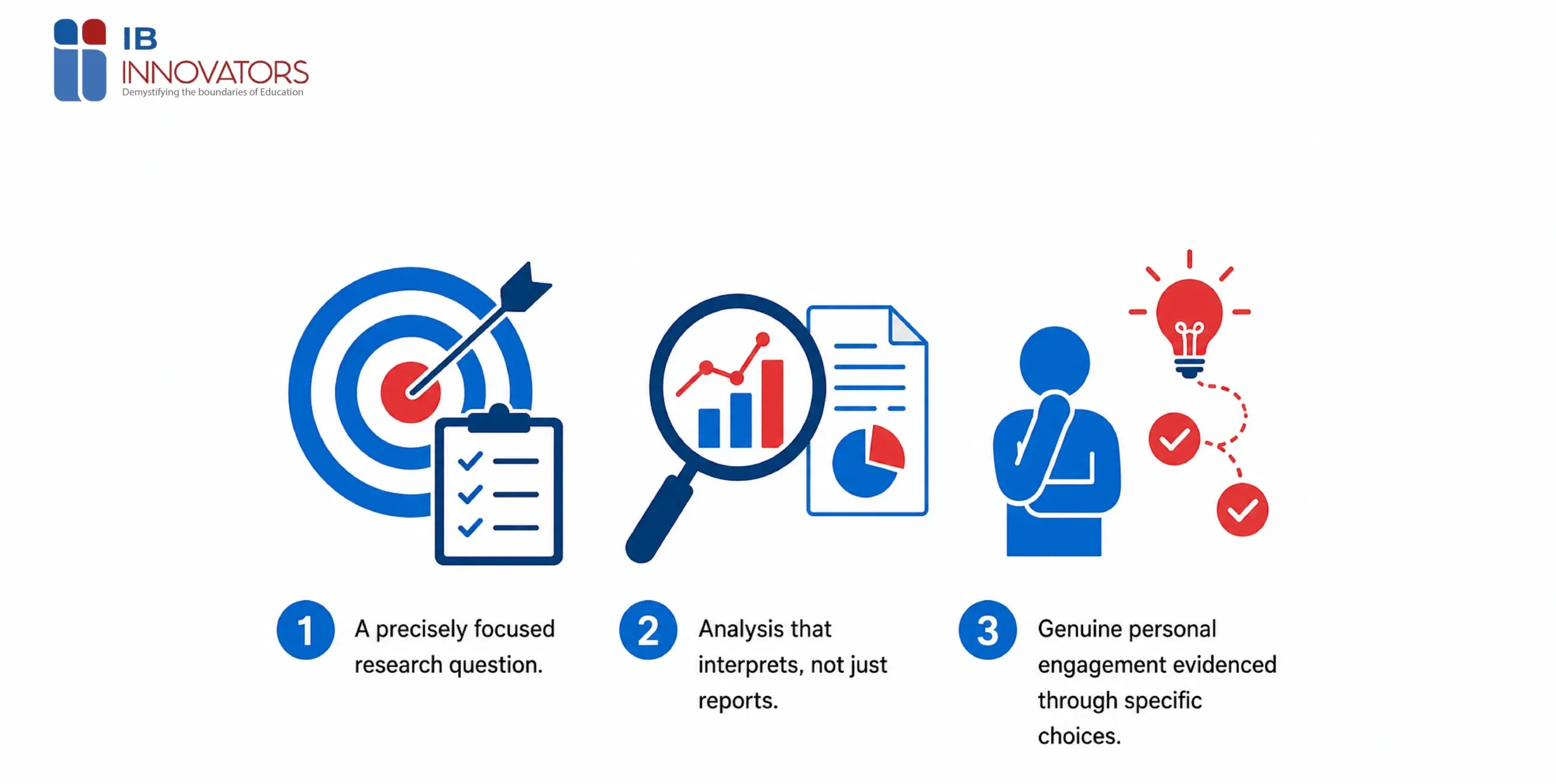
First: a precisely focused research question. The research question must be specific enough that the entire investigation can address it completely within the assessment’s scope. Broad, generic questions produce broad, unfocused analysis — and lose marks under the presentation and focus criteria before a single calculation has been evaluated. A strong research question names a specific variable, a defined context, and a testable relationship.
Second: analysis that interprets, not just reports. Every subject’s IA rubric rewards analysis that explains what results mean for the research question — not merely what the results are. This distinction is one of the most consistent differences our examiners observe between grade 5 and grade 7 work. Students who state ‘the results show x = 5’ score lower than students who explain ‘the value of x = 5 suggests that Y, which supports / contradicts the hypothesis because Z.’
Third: genuine personal engagement evidenced through specific choices. Examiners across all subjects are looking for evidence that the investigation reflects the student’s own thinking — not just the execution of a standard template. This is not about stating your interest in the topic. It is about making specific methodological decisions, justifying them, and reflecting honestly on what they meant for your results.
When we mark a strong IA, the examiner’s first question is whether the research question is focused enough to be fully addressed. The second is whether the analysis genuinely addresses it. Those two questions determine the trajectory of the rubric score for every subject we mark — Biology, Chemistry, Maths, Economics, or Psychology.
Grade 7 vs Grade 5 – What Examiners See Differently
The difference between a grade 5 and a grade 7 IA is rarely the quality of the underlying science or mathematics. It is almost always the quality of the communication, the depth of the reflection, and the specificity of the personal engagement. Here is how that difference manifests, criterion by criterion, in the IAs our examiners mark:
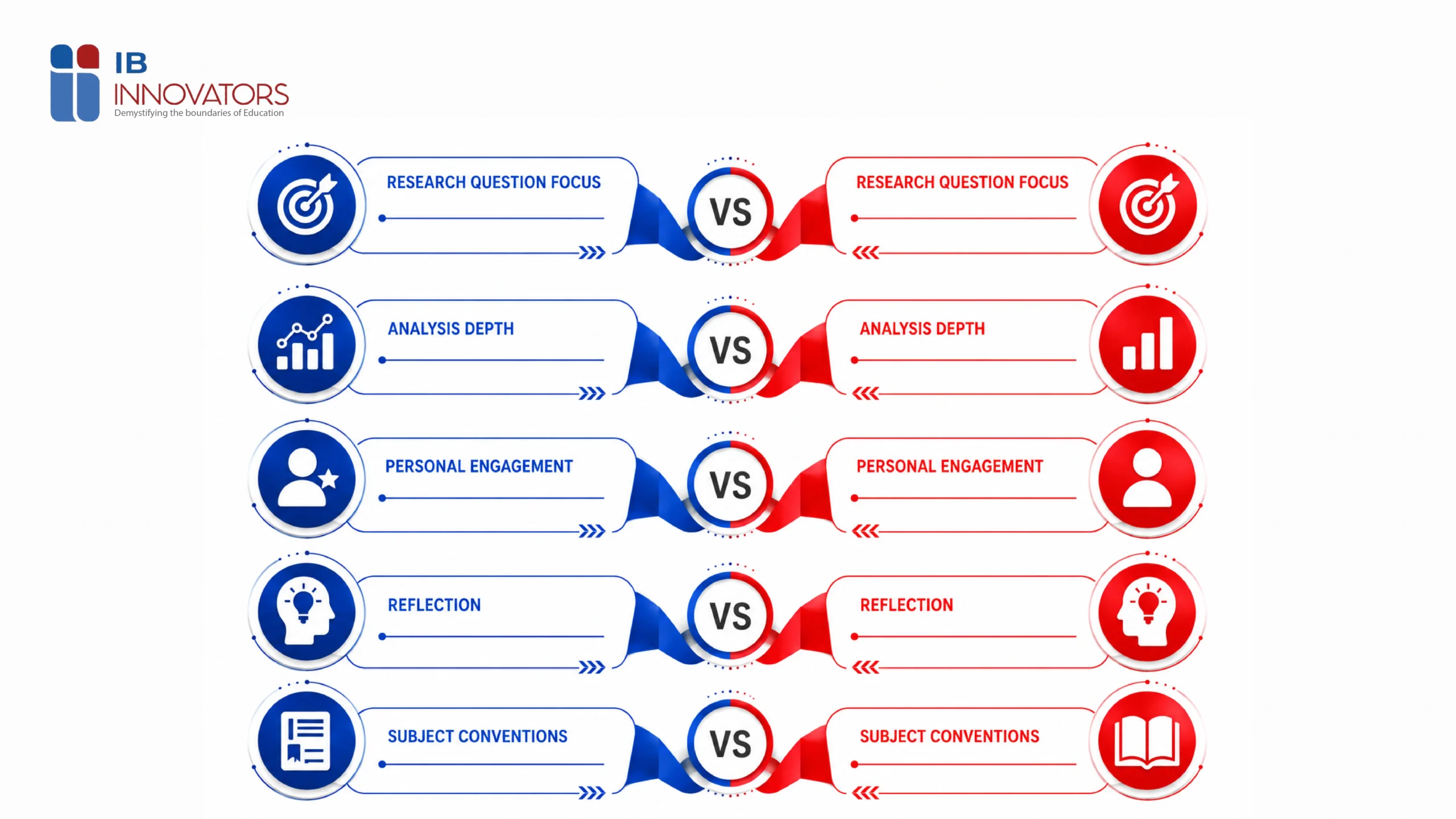
| Dimension | Grade 7 IA | Grade 5 IA |
| Research question focus | Precise, testable, constrained to one specific relationship or variable within a defined context | Broad, generic, partially testable — leaves the examiner unclear about what ‘success’ looks like |
| Analysis depth | Results interpreted in context of the research question — what they mean, not just what they are; limitations quantified where possible | Results stated accurately but not interpreted; limitations listed generically without specifying their probable effect |
| Personal engagement | Engagement evidenced through specific methodological choices — why this method, why this scope, what the student’s own context contributed to the design | Engagement declared in the introduction (‘I chose this because I find it interesting’) — not evidenced through the investigation itself |
| Reflection | Woven throughout the analysis and consolidated in the conclusion; limitations are specific (named effect, probable magnitude, specific improvement) | Present only in the conclusion; generic (‘human error may have affected results’, ‘a larger sample size would improve the study’) |
| Subject conventions | Correct methodology for the subject applied consistently — statistical tests in Sciences, economic theory in Economics, defined formulas in Maths — with results interpreted using that framework | Methodology present but inconsistently applied; results reported without connecting them back to the subject’s theoretical or analytical framework |
The most reliable single action a student can take to move from grade 5 to grade 7 territory is to review every result in their IA and ask: what does this mean for my research question? If the answer to that question does not appear in the text, it needs to be written. That is the analysis gap our examiners see most frequently — across every subject.
IB IA Examples by Subject – Examiner Breakdown
The following subject-by-subject breakdown draws on the marking experience of IB Innovators’ certified IB examiner team across May and November examination sessions. For each subject, we describe what top-scoring Internal Assessments consistently demonstrate — the structural patterns, the analytical depth, and the rubric-specific qualities that distinguish high-scoring from average work. This is not a reproduction of IB-published exemplars. It is examiner-informed analysis of the patterns that produce top scores.
| IB Biology Internal Assessment Examples – What Top Scores Look Like |
IB Biology IA format: Scientific investigation comprising a research question, methodology, raw data collection, data processing and analysis, conclusion, and evaluation.
In a top-scoring IB Biology IA, the research question identifies a specific independent variable, a measurable dependent variable, and a defined range or condition — for example, examining how a specific factor influences a measurable biological process under controlled conditions. The methodology demonstrates clear experimental control — identifying and managing all relevant variables — and includes sufficient repetition to enable statistical analysis.
What distinguishes high-scoring Biology IAs in the data analysis section is the application of appropriate statistical tests — correctly selected (t-test, chi-squared, standard deviation, or others appropriate to the data type), correctly executed, and — most importantly — correctly interpreted. Stating that a t-test gives a p-value of 0.03 is not analysis. Stating that ‘a p-value of 0.03 (< 0.05) indicates a statistically significant difference between the two conditions, supporting the hypothesis that X influences Y’ is analysis.
Examiner observation: The section that most often prevents an otherwise strong Biology IA from reaching grade 7 is the evaluation. Students frequently list ‘human error’ or ‘small sample size’ as limitations. Top-scoring evaluations name the specific limitation, explain what effect it likely had on the data (overestimation, underestimation, increased variance), and propose a specific methodological improvement — not a generic one. ‘Increasing the sample size’ is generic. ‘Increasing n from 8 to 30 to satisfy the minimum requirement for a valid parametric t-test’ is specific.
HL vs SL: Biology HL IAs are expected to demonstrate greater experimental complexity and a higher level of statistical analysis than SL. Both levels are assessed against the same five criteria, but examiner expectations for the depth of analysis and evaluation scale accordingly.
| Raiaab, studying with IB Innovators from Pakistan, scored 7 in Biology with foundation building and targeted resource support from our certified Biology examiners. |
See our dedicated Biology IA guidance for criterion-specific support — links consolidated in the How IB Innovators Helps section below.
| IB Chemistry Internal Assessment Examples – Examiner Observations |
IB Chemistry IA format: Scientific investigation — emphasis on rigorous data processing, uncertainty analysis, and methodological precision throughout.
A top-scoring IB Chemistry IA begins with a research question that specifies the chemical system being investigated, the variable being manipulated, and the measurable output. Vague questions like ‘how does concentration affect reaction rate?’ lose marks under Criterion A. Precise questions that name the specific reaction, the concentration range, and the measurement method create a framework that the entire investigation can address.
The data processing section is where Chemistry IAs most frequently differentiate at the top end. High-scoring IAs process data correctly and completely — mean values, standard deviation, propagated uncertainties at each stage — and, critically, explain what each processing step demonstrates. Turning a data table into a graph is data presentation. Explaining what the gradient of that graph represents in terms of the reaction kinetics is data processing that earns Criterion C marks.
Examiner observation: Chemistry IAs frequently lose Criterion C (Analysis) marks because students process data correctly but describe rather than analyse. A top-scoring Chemistry IA connects every calculation to the research question: ‘The calculated rate constant of X mol L⁻¹ s⁻¹ at this temperature indicates Y, which is consistent with / contradicts the predicted relationship because Z.’ That connection — between the number and the question — is what examiners are marking.
HL vs SL: Chemistry HL IAs often involve more complex data processing and may include more sophisticated experimental designs (multi-variable investigations, advanced analytical techniques). Both HL and SL must satisfy all five IA criteria.
| Annalia, studying with IB Innovators from the Netherlands, improved her Chemistry grade from 4 to 6 through focused IA support and exam practice with our certified Chemistry examiners. |
See our dedicated Chemistry IA guidance for criterion-specific support — links consolidated in the How IB Innovators Helps section below.
| IB Physics Internal Assessment Examples – What Distinguishes High Scores |
IB Physics IA format: Experimental investigation — strong emphasis on systematic data collection, uncertainty analysis, and the relationship between experimental results and physical theory.
In a top-scoring IB Physics IA, uncertainty analysis is not an afterthought — it is a structural feature of the investigation. High-scoring Physics IAs calculate absolute and percentage uncertainties at every stage of data processing, propagate them correctly through derived quantities, and — most importantly — use the final uncertainty range to evaluate whether the result is consistent with the theoretical or literature value.
The conclusion of a top-scoring Physics IA does not simply state the measured value of a quantity. It compares the measured value with the accepted or theoretical value, evaluates whether the discrepancy is within the experimental uncertainty, and discusses whether the hypothesis is supported. A measurement of g = 9.4 ± 0.6 m s⁻² is not ‘inconsistent with 9.81 m s⁻²’ — it is within experimental uncertainty. Recognising and articulating that is what distinguishes a grade 7 Physics IA conclusion.
Examiner observation: The most consistent difference between grade 7 and grade 5 Physics IAs is the quality of the uncertainty analysis. Average IAs acknowledge uncertainty in the method section and then ignore it in the data analysis. Top-scoring Physics IAs treat uncertainty as an analytical tool — propagating it through every calculation and using the final uncertainty range to evaluate the validity of the conclusion.
HL vs SL: Physics HL IAs are expected to demonstrate greater analytical sophistication. HL students may be expected to use more advanced data analysis techniques. Both levels are assessed against the same criteria, but examiner expectations for HL depth are higher.
| IB Environmental Systems & Societies (ESS) IA Examples |
IB ESS IA format: Environmental investigation — may involve fieldwork data collection, secondary data analysis, or systems modelling; uniquely cross-disciplinary, drawing on both scientific methodology and socio-environmental analysis.
A top-scoring IB ESS IA situates its investigation within the ESS conceptual framework — systems thinking, ecosystem services, environmental value systems — rather than treating it as a pure science experiment with an environmental topic. The research question specifies an environmental context, an investigable relationship, and a measurable output that connects to ESS systems concepts.
High-scoring ESS IAs demonstrate environmental interpretation of results — not just ecological or chemical analysis. This means connecting findings to broader environmental significance: what do the results suggest about the health of the system studied? What are the management implications? What are the limitations of drawing conclusions from localised data about broader environmental patterns?
Examiner observation: ESS IAs that score highly are those where the student’s personal environmental context is genuinely visible in the investigation — not just as a topic choice, but in how the data is interpreted and evaluated. ESS is an interdisciplinary subject. The best IAs reflect that by situating results within the ESS systems framework rather than treating the investigation as a stripped-down biology or geography study.
| IB Mathematics IA Examples – AA and AI Breakdown |
IB Mathematics IA format: Mathematical exploration — approximately 12–20 pages; assessed against five criteria totalling 20 marks: Criterion A (Presentation, 4 marks), Criterion B (Mathematical Communication, 4 marks), Criterion C (Personal Engagement, 3 marks), Criterion D (Reflection, 3 marks), Criterion E (Use of Mathematics, 6 marks).
Criterion E carries the highest mark allocation — 6 of 20 marks — and is the criterion that most directly differentiates grade 6 from grade 7 work. For Math AA (Analysis and Approaches) students, top-scoring IAs use mathematics that is both correct and sophisticated relative to the AA course — abstract reasoning, calculus applied with genuine insight, algebraic structures explored beyond textbook methods. For Math AI (Applications and Interpretation) students, top-scoring IAs apply mathematical tools correctly to a real-world context — statistical modelling, differential equations in applied settings, or technology-supported investigation — with results interpreted in terms of their real-world significance.
Every formula, theorem, and mathematical technique in a top-scoring Maths IA is introduced and defined before it is used. This is Criterion B (Mathematical Communication) in practice. Writing ‘the sum to infinity formula S∞ = a/(1−r)’ without defining what a and r represent in the context of the exploration — and why this formula is being applied at this step — loses Criterion B marks even if the application is correct.
Examiner observation: The most common reason Maths IAs score a 5 rather than a 7 is Criterion E. Students often use correct mathematics but at a level below what their course expects — particularly in AA HL, where examiners look for genuine mathematical sophistication. Using only SL-level mathematics in an HL IA will limit Criterion E marks even if every other criterion is strong. The mathematics must be appropriate to the course level, applied correctly, and used with genuine insight.
AA vs AI distinction: The five-section structure and five rubric criteria are identical for both AA and AI. What differs is the mathematical style and depth expectation in Criterion E. AA IAs are expected to demonstrate abstract and analytical mathematical reasoning. AI IAs are expected to demonstrate applied mathematical modelling with appropriate technology use and real-world interpretation.
See also: For a complete rubric-aligned guide to structuring your Mathematics Internal Assessment, see our dedicated guide: Maths IA Structure and Format Guide
| Yaroslav, studying with IB Innovators from Spain, improved his Maths AA HL score to 6 after working with one of our certified Maths examiners on both the structure and mathematical depth of his IA. |
| Erolia, studying with IB Innovators from Albania, improved her Maths AI score to 6 and strengthened her IA through targeted 1-on-1 IA guidance sessions with our team. |
See our dedicated Mathematics IA guidance for criterion-specific support — links consolidated in the How IB Innovators Helps section below.
| IB Economics Internal Assessment Examples – What Examiners Reward |
IB Economics IA format: Three economic commentaries — each a maximum of 800 words — on current economic news articles, each drawing on a different section of the IB Economics syllabus (Microeconomics, Macroeconomics, and International Economics or Development Economics).
A top-scoring IB Economics IA begins with the selection of a high-quality news article — one that reports a specific, identifiable economic event or policy, not simply an article that mentions economic topics. The commentary must then apply economic theory precisely to that specific event: identifying the relevant concept, constructing and explaining an accurate, well-labelled diagram, and using economic analysis to evaluate the implications.
The most important thing to understand about top-scoring Economics IAs is the role of the diagram. In a grade 7 commentary, the diagram is an analytical instrument — not an illustration. The writer uses it to show a shift, explain what caused that shift, identify the new equilibrium, and discuss what economic consequences follow. In a grade 5 commentary, the diagram is present and correctly labelled, but the text describes it rather than using it to make an argument. That difference in diagram usage often determines whether a commentary scores a 3 or a 4 out of 5 on the analysis criterion.
Examiner observation: Economics IAs also frequently lose marks through insufficient evaluation. ‘This policy will reduce unemployment but may cause inflation’ is a statement, not evaluation. A top-scoring commentary evaluates by comparing the magnitude of effects, the timescale over which they operate, who benefits and who is disadvantaged, and whether the theoretical prediction matches the evidence in the article. That depth of economic judgement is what distinguishes a grade 7 commentary.
HL vs SL: Economics HL and SL students follow the same commentary format. HL students cover additional syllabus topics (in particular, the extended treatment of macroeconomics and international economics) which may appear in their commentary selections.
See our dedicated Economics IA guidance for criterion-specific support — links consolidated in the How IB Innovators Helps section below.
| IB Business Management IA Examples – HL vs SL |
IB Business Management IA formats: HL students complete a written commentary of approximately 1,500–2,000 words analysing a real business issue using primary and secondary research. SL students complete a research project of approximately 1,500–2,000 words examining a specific business decision or problem for a real organisation.
A top-scoring IB Business Management IA identifies a specific, researchable business problem or decision — not a broad description of a company or sector. The investigation applies Business Management tools (SWOT analysis, ratio analysis, cash flow forecasting, decision trees, Ansoff matrix, or others as appropriate) not to demonstrate knowledge of the tools but to reach a conclusion about the business problem.
The distinction that most consistently differentiates grade 7 from grade 5 Business Management IAs is how BM tools are used. A SWOT analysis that lists factors without prioritising them or connecting them to the specific business decision adds description, not analysis. A top-scoring IA uses each BM tool to answer a question about the business — and the conclusion flows directly from what the tools reveal.
Examiner observation: Primary research in Business Management IAs often determines the ceiling of the mark. Students who collect generic survey data without a clear analytical purpose produce descriptions of what their respondents said. Students who design primary research with specific questions tied to the business decision — and then analyse the responses in terms of what they reveal about that decision — produce evidence-based analysis that earns the top marks for research methodology.
HL vs SL distinction: HL Business Management IAs (written commentary) typically involve greater depth of secondary research and a broader range of BM tools. SL research projects have a clear research question that structures the entire investigation. Both formats require the same commitment to evidence-based analysis and genuine application of BM concepts.
| IB Psychology Internal Assessment Examples – Experimental Study Breakdown |
IB Psychology IA format: Experimental study — students design and conduct a simple experiment that replicates or extends a published psychological study. The report must include: aim, hypothesis (directional or null), research design, participants, materials, procedure, results (descriptive and inferential statistics), discussion, conclusion, and references.
A top-scoring IB Psychology IA is grounded in a clear, directional hypothesis that follows directly from the aim and from the theoretical basis of the study being replicated. The research design — independent measures, repeated measures, or matched pairs — is explicitly chosen, correctly named, and justified in terms of the study’s aim. Ethical considerations (informed consent, right to withdraw, debriefing) are documented and applied, not merely listed.
The discussion section is where Psychology IAs most frequently differentiate between grade 5 and grade 7. A grade 5 discussion reports whether the hypothesis was supported and lists one or two generic methodological improvements. A grade 7 discussion connects the results to the original study being replicated (were the findings consistent or inconsistent, and what does that suggest?), applies relevant psychological theory to explain the pattern, and evaluates the design’s internal and external validity with specificity — naming the particular threat to validity, explaining its probable effect, and proposing a specific improvement.
Examiner observation: Psychology IAs frequently lose marks in the discussion section because students treat it as a summary rather than an analysis. A top-scoring discussion asks: what do my results mean in the context of the psychological theory? How do they compare to what the original researchers found? What does any discrepancy tell us about the conditions under which the effect is reliably observed? Answering those questions is what distinguishes an excellent Psychology IA from a competent one.
HL vs SL: Psychology HL and SL follow the same experimental IA format. HL students are expected to demonstrate greater analytical depth in the discussion section, particularly in connecting results to the broader body of psychological research.
| Aman, studying with IB Innovators from Germany, improved his Psychology grade from 4 to 6 and achieved 38 total IB points with support from our subject specialist examiner team. |
Individual results vary and depend on each student’s starting point, effort, and timeline.
How the IA Rubric Manifests in Top-Scoring Work
Two rubric criteria are consistently misunderstood across all IBDP IA subjects: Personal Engagement and Reflection. Understanding how these criteria manifest in actual top-scoring work — rather than in abstract rubric language — is one of the most direct ways to improve an IA that is already technically competent.
Personal Engagement in top-scoring IAs. Examiners do not award Personal Engagement marks for stating interest. They award them for evidence that the student’s own perspective, curiosity, or context has shaped the investigation in a specific and visible way.
What this looks like in practice: choosing a non-standard methodology and explaining why it better addresses your specific question; connecting the investigation to a real context from your own environment and then explaining how that context influenced the design choices; acknowledging a point in the investigation where your results surprised you and describing how that changed your approach. These are evidenced forms of engagement. ‘I chose this topic because I find it fascinating’ is a declaration — it earns no Criterion C marks.
Reflection in top-scoring IAs. Reflection is not confined to the conclusion. In a top-scoring IA, reflection is woven through the analysis — noting where results were unexpected, considering what the methodology’s constraints mean for the confidence of the findings, and proposing extensions that arise naturally from what the investigation revealed.
The most important distinction in high-scoring reflection is specificity. A generic limitation states: ‘A larger sample size would have improved the reliability of the results.’ A specific reflection states: ‘The sample of n = 12 was insufficient to meet the minimum requirement for a valid parametric test at the 0.05 significance level. Increasing n to at least 30 in a future study would enable a more robust statistical test and strengthen the confidence of the conclusion.’ That specificity — naming the effect, the mechanism, and the precise improvement — is what the top mark in Criterion D looks like.
Common IA Weaknesses That Prevent Top Scores
Based on the marking experience of our certified IB examiner team across May and November sessions, these are the most frequently recurring weaknesses that prevent otherwise competent IAs from reaching grade 7:
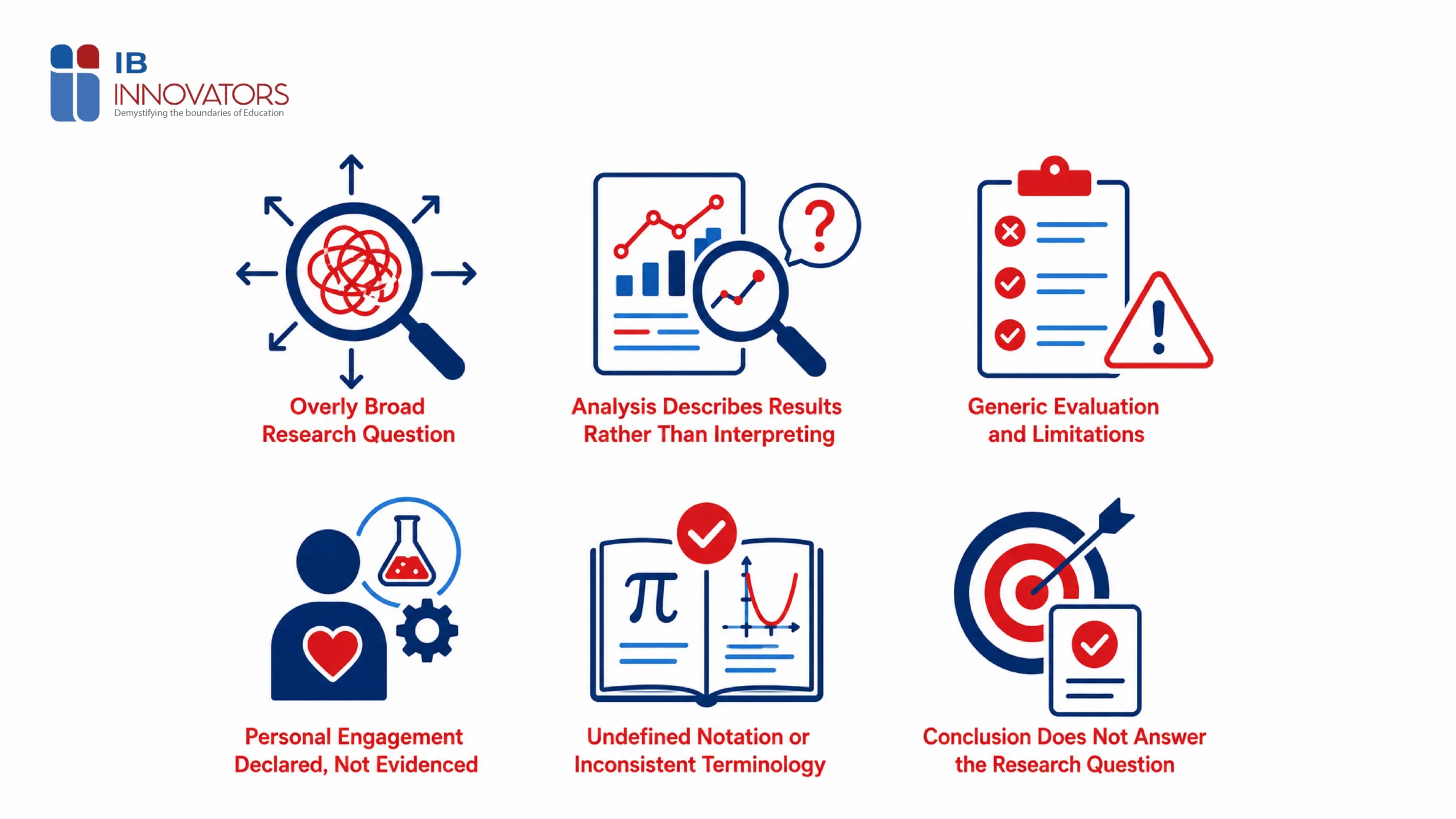
| Common Weakness | Criterion Affected | How to Address It |
| Overly broad research question | Criterion A – Presentation / Focus | Narrow to one specific variable, one defined context, one measurable relationship. Test: can this question be fully answered within the IA’s page or word limit? |
| Analysis describes results rather than interpreting them | Criterion C/D/E (subject-dependent) | For every result: ask ‘what does this mean for my research question?’ before writing. If the text cannot answer that, add the interpretation. |
| Generic evaluation and limitations | Criterion D – Reflection | Replace generic limitations with specific ones: name the effect, estimate the probable magnitude, propose a specific improvement — not a generic one. |
| Personal engagement declared, not evidenced | Criterion C – Personal Engagement | Show how your personal context shaped specific methodological choices. Remove statements of interest; add evidence of individual thinking in the design. |
| Undefined notation or inconsistent terminology | Criterion B – Mathematical Communication (Maths); Communication (Sciences) | Introduce and define every term, formula, and symbol on first use. Maintain consistent notation throughout — do not switch between variable names. |
| Conclusion does not answer the research question | Criterion A – Presentation | Open the conclusion with a direct, explicit answer to the research question before adding reflection and extension. The connection must be stated, not implied. |
How IB Innovators Helps You Achieve Your Best IA Score
IB Innovators is a specialised online IB tutoring platform backed by deep expertise in IB education and a roster of our examiner-led team across all IBDP subjects. We have supported students at every stage of the Internal Assessment process — from research question selection through to final submission — across all IB Diploma Programme subjects.
Our 1-on-1 IA & EE Guidance service pairs you directly with a Senior IB Examiner — not a generic tutor, but the same professionals who actively mark IA submissions in the May and November examination sessions. This means the feedback you receive is not interpretive — it is examiner-informed assessment and feedback on what your IA demonstrates against each rubric criterion.
What our IA guidance sessions cover:
- Research question review — is your question specific, testable, and appropriately scoped for your IA’s requirements?
- Section-by-section rubric alignment review — what each section of your IA currently demonstrates against each criterion
- Mathematical communication review (Maths IAs) — formula definition, notation consistency, and criterion B alignment
- Analysis depth assessment — are your results being described or interpreted? Criterion-specific feedback
- Personal engagement evidence review — how to make engagement visible through methodological choices, not declarations
- Reflection specificity coaching — how to transform generic limitations into specific, high-scoring evaluation
- Final examiner-perspective read-through before submission
IB Innovators tutors provide guidance, structured feedback, and quality improvement strategies. They do not write coursework for students. The work is yours — the examiner-level insight is ours.
Our sessions are delivered through our online learning platform — IB Innovators’ online platform featuring a digital whiteboard, recorded session playback, and flexible scheduling across UAE, UK, and USA time zones.
Subject-Specific IA Guidance — Confirm URLs Before Publishing:
Our subject IA guidance pages — confirm destination URLs with the client before publishing:IB Biology Tutors •IB Chemistry Tutors •IB Mathematics Tutors •IB Economics Tutors
1-on-1 IA & EE Guidance with Certified IB Examiners — £55/hr Book a free 30-minute consultation to discuss your IA subject and current stage. No commitment required — just examiner-level insight from the people who mark the actual papers. |
For DP2 students balancing IA submission with exam preparation, our Winter Bootcamp provides 12 hours of examiner-led revision from £540 per subject — running December to January, led exclusively by Expert Tutors (certified IB examiners with 7+ years of experience), and strategically timed between mock examinations and the May session.
If you are also planning your Extended Essay alongside your IA, our guide onhow to choose your EE topic covers subject selection, research question scoping, and EE-specific criteria.