

|
Quick Answer: The IB Diploma Programme (IBDP) is a two-year, internationally recognised pre-university qualification for students aged 16 to 19. Developed by the International Baccalaureate Organisation, it combines six subject groups with three core components, assessed on a scale of 1 to 45 points, and accepted by universities in over 100 countries. |
Whether you are a student preparing to enter Year 12, a parent comparing curricula, or a school-switcher navigating international education for the first time, this guide covers everything you need to know about the IB Diploma Programme. We have built this guide to bring together what the IB publishes with what our examiners see matter in practice.
At IB Innovators, our tutors and IB Examiners work with IBDP students every day. What you will find in this guide reflects not just what the IB organisation publishes, but what actually matters when students sit down to study and perform under pressure.
What Is the IB Diploma Programme?
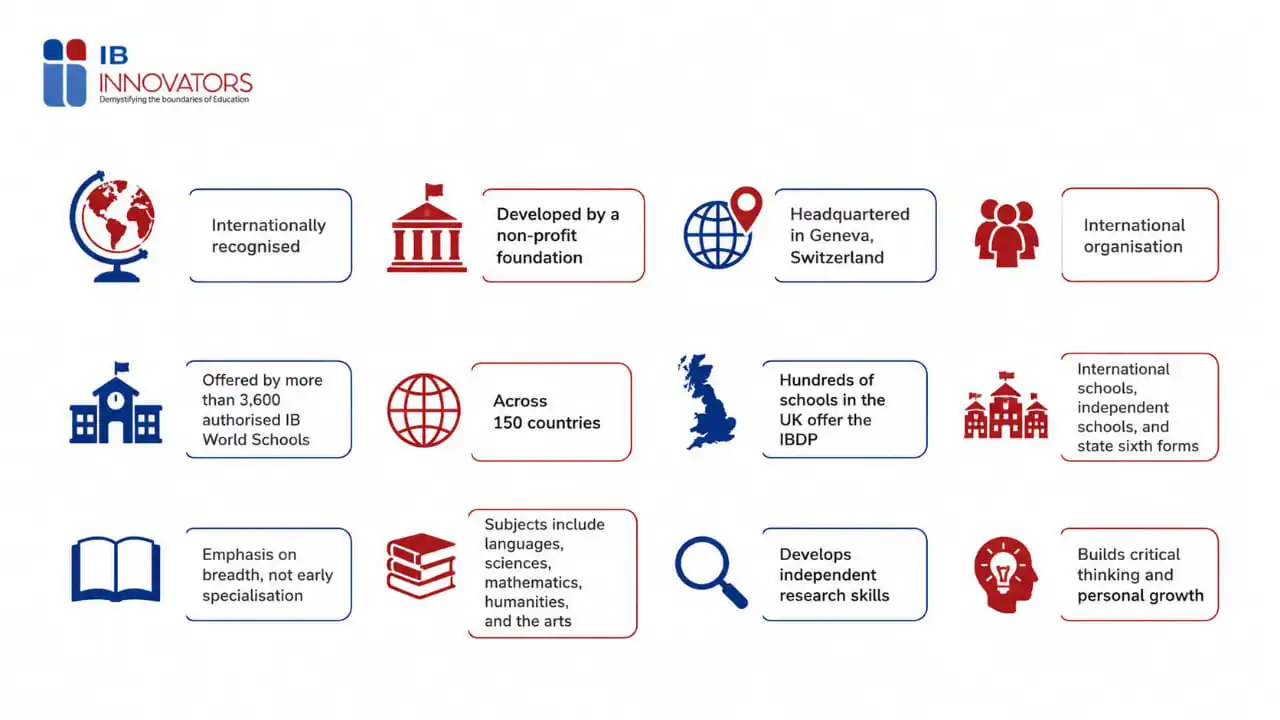
The International Baccalaureate Diploma Programme is a pre-university curriculum developed by the International Baccalaureate Organisation, a non-profit educational foundation headquartered in Geneva, Switzerland. The organisation itself is international, not American, British, or aligned to any single national education system. This independence is central to its worldwide credibility.
The programme is offered by more than 3,600 authorised IB World Schools across 150 countries. In the United Kingdom alone, hundreds of international schools, independent schools, and state sixth forms offer the IBDP as an alternative to A-Levels.
What sets the IB Diploma apart from most national qualifications is its deliberate refusal to specialise early. Rather than narrowing a student’s focus to two or three subjects, the IBDP requires breadth across languages, sciences, mathematics, humanities, and the arts, while also developing independent research skills, critical thinking, and personal growth through its core components.
Where the IB Diploma Fits: The Full IB Continuum
The IB Diploma is the third stage of a four-programme educational continuum. Students do not need to have completed earlier IB programmes to enter the Diploma, but understanding the continuum helps clarify where the IBDP sits in the wider educational landscape.
|
IB Programme |
Age Range |
Primary Focus |
|
Primary Years Programme (PYP) |
Ages 3 to 12 |
Inquiry-based, transdisciplinary learning |
|
Middle Years Programme (MYP) |
Ages 11 to 16 |
Subject-area teaching with interdisciplinary connections |
|
Diploma Programme (DP) |
Ages 16 to 19 |
Six subject groups plus three core components. University preparation. |
|
Career-related Programme (CP) |
Ages 16 to 19 |
Vocational pathway combined with IB core elements |
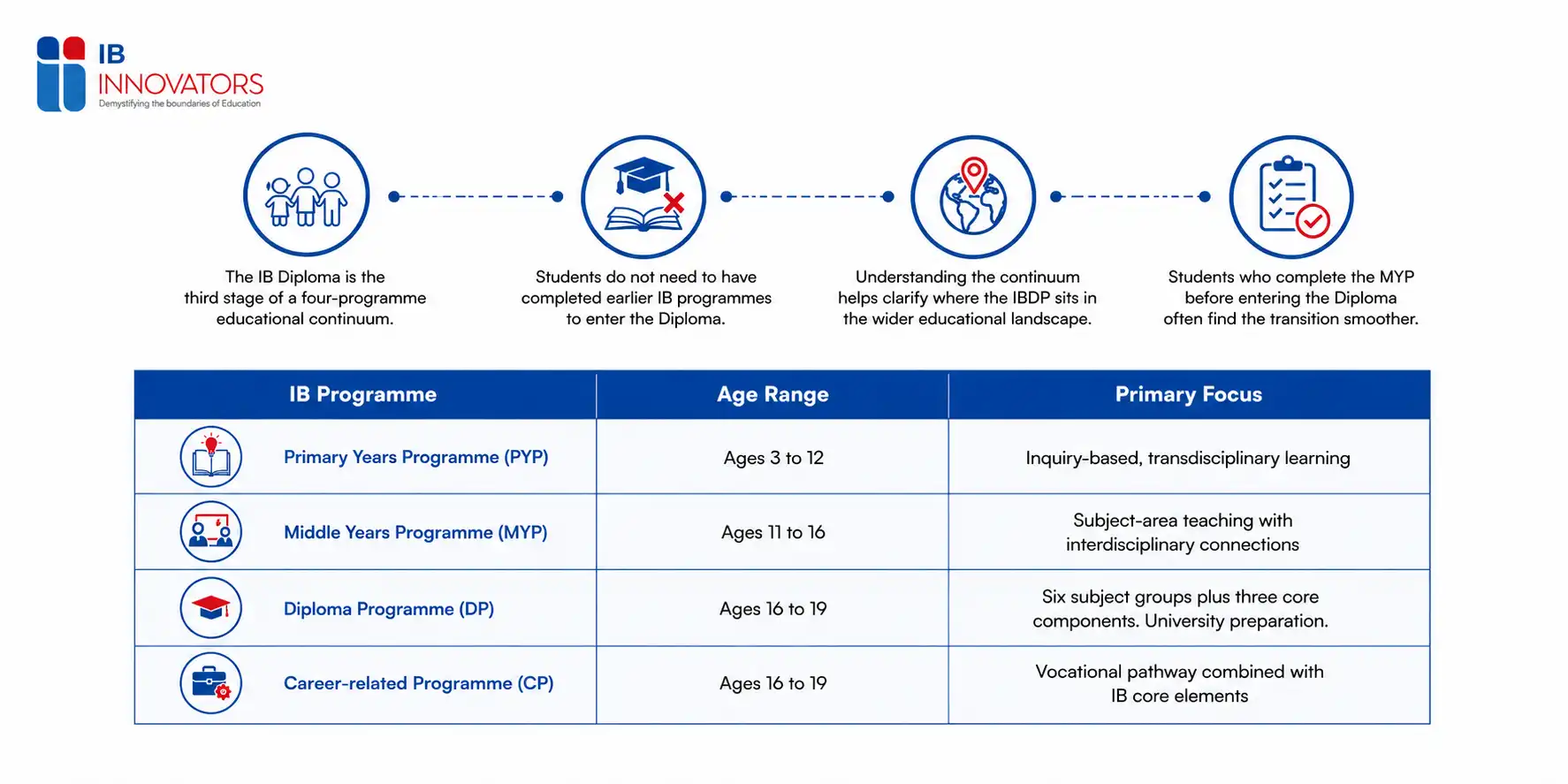
Students who complete the MYP before entering the Diploma often find the transition smoother, since they are already familiar with IB assessment criteria and the inquiry-based learning approach. However, the Diploma is open to students from any prior curriculum, including GCSE, IGCSE, CBSE, and American high school systems.
How the IB Diploma Programme Is Structured
The IBDP curriculum is built around a core model: six subject groups plus three mandatory core components. Students select one subject from each group and must complete all three core requirements. This architecture is designed to produce graduates who are both knowledgeable in specific disciplines and capable of thinking across them.
The programme runs over two academic years, typically Years 12 and 13 in the UK system, or Grades 11 and 12 in the American system.
The Six IB Subject Groups
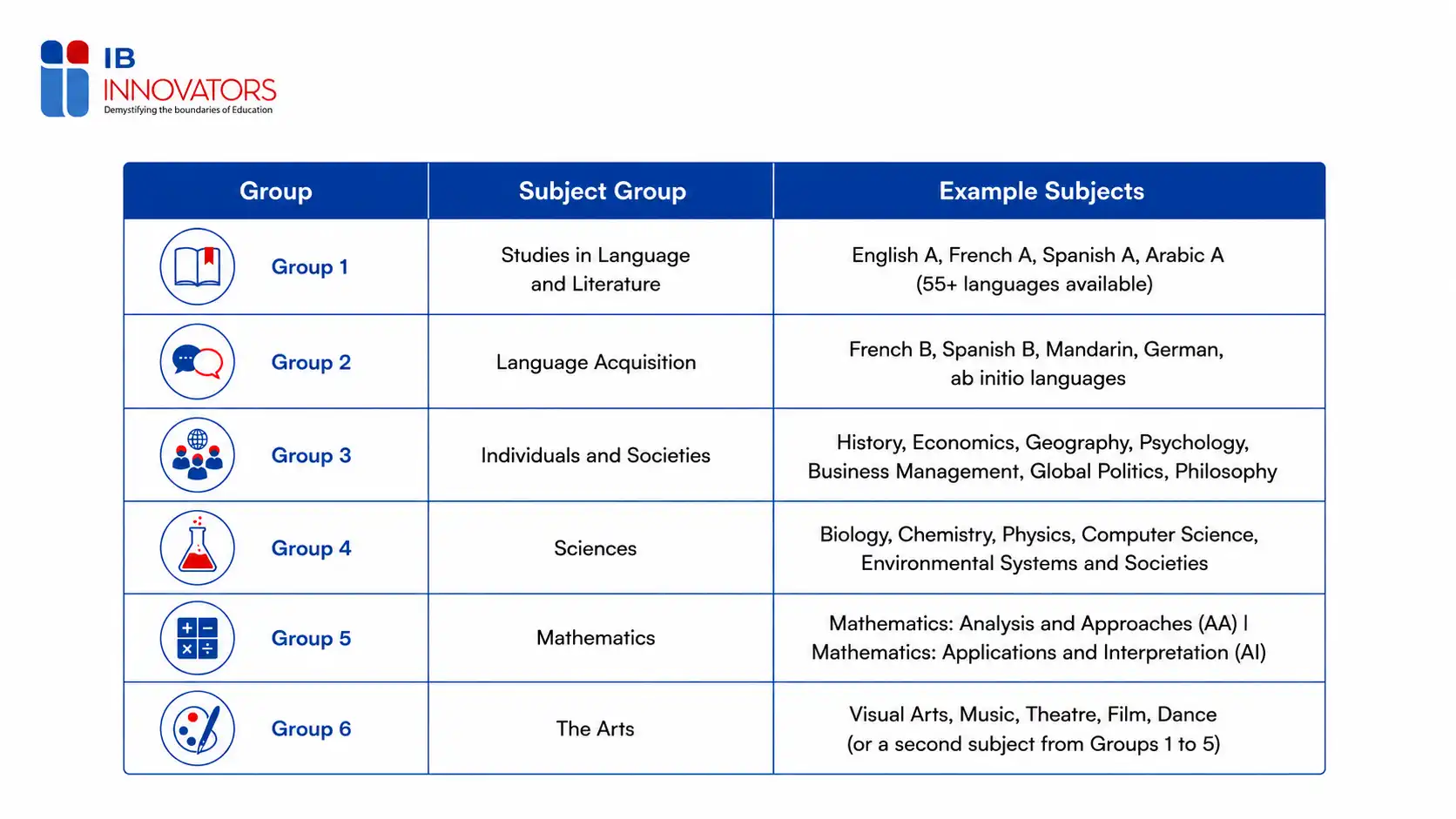
Every IBDP student studies one subject from each of the following six groups. There is some flexibility: students may replace the arts subject with an additional subject from Groups 1 to 5 if their academic or university goals require it.
|
Group |
Subject Group |
Example Subjects |
|
Group 1 |
Studies in Language and Literature |
English A, French A, Spanish A, Arabic A (55+ languages available) |
|
Group 2 |
Language Acquisition |
French B, Spanish B, Mandarin, German, ab initio languages |
|
Group 3 |
Individuals and Societies |
History, Economics, Geography, Psychology, Business Management, Global Politics, Philosophy |
|
Group 4 |
Sciences |
Biology, Chemistry, Physics, Computer Science, Environmental Systems and Societies |
|
Group 5 |
Mathematics |
Mathematics: Analysis and Approaches (AA) | Mathematics: Applications and Interpretation (AI) |
|
Group 6 |
The Arts |
Visual Arts, Music, Theatre, Film, Dance (or a second subject from Groups 1 to 5) |
Higher Level and Standard Level: What the Difference Actually Means
|
Unique to this guide: This section covers the HL vs SL distinction in the level of practical detail that no other IBDP guide provides. Understanding teaching hours matters when choosing subjects. |
Every IBDP student studies three subjects at Higher Level (HL) and three at Standard Level (SL). This is not simply a difficulty label. It represents a meaningful difference in teaching time, content depth, and assessment scope.
- Higher Level (HL): Approximately 240 teaching hours over the two-year programme. HL courses go into considerably greater breadth and depth than their SL equivalents. Many universities specify minimum HL grades for competitive courses.
- Standard Level (SL): Approximately 150 teaching hours over the two years. SL content is still rigorous but covers fewer topics and in less depth than HL.
The HL and SL versions of most subjects share some content but diverge significantly in their additional topics, Internal Assessment requirements, and the difficulty of examination questions. A student taking IB Chemistry HL will cover topics such as organic synthesis and spectroscopy that are not present in Chemistry SL at all.
Choosing HL subjects wisely is one of the most consequential decisions a student makes at the start of the Diploma. Common pairings include:
- Aspiring medical or bioscience students: HL Biology and HL Chemistry
- Engineering or mathematics pathways: HL Mathematics AA and HL Physics
- Economics, law, or social science: HL Economics, HL History, or HL Business Management
- Languages or humanities: HL English A and HL History or Geography
Our expert IB tutors can help you choose the right HL combination for your university goals and strengths from the very start of the programme.
The Three Core Components of the IB Diploma
The three core components are what truly distinguish the IB Diploma from every other pre-university qualification. All three are compulsory. No student can receive the Diploma without satisfying each of them. The core sits at the philosophical heart of the programme, developing capacities that go beyond subject knowledge.
The Extended Essay
The Extended Essay (EE) is a formal independent research paper of up to 4,000 words. Students choose a research question within one of their six subjects, conduct original inquiry, and produce a structured academic argument under the supervision of a school mentor.
The Extended Essay is externally assessed by IB Examiners and graded A to E. It is widely regarded as one of the best forms of preparation for university-level research and dissertation writing. Students who complete a strong EE often report feeling significantly more confident in their first year of higher education when their peers are encountering independent research for the first time.
The EE is assessed alongside a reflective component called the Researcher’s Reflection Space (RRS), which documents the student’s intellectual journey through the research process.
IB Innovators provides dedicated guidance and support sessions for Extended Essay planning, topic selection, structure, and draft feedback.
Creativity, Activity, Service
Creativity, Activity, Service (CAS) requires students to engage in a structured programme of creative, physical, and community-oriented activities throughout the two years. CAS is not a subject. It is not graded. But failure to complete the CAS requirements means the Diploma is not awarded, regardless of subject scores.
CAS is organised around three strands:
- Creativity: Engaging with the arts or developing creative thinking, such as learning an instrument, directing a school production, or designing a website.
- Activity: Physical exertion contributing to a healthy lifestyle, such as competitive sport, dance, or regular training.
- Service: Unpaid, voluntary engagement with a community, such as tutoring younger students, working with local charities, or organising fundraising events.
Students must complete at least one CAS project that demonstrates sustained collaboration and initiative. CAS reflections are documented regularly, often through a platform such as ManageBac. Many students describe CAS as some of the most memorable and personally significant work they do during the programme.
Theory of Knowledge
Theory of Knowledge (TOK) is a course in critical thinking and epistemology that runs throughout the two-year programme. It asks students to examine how we know what we claim to know, exploring the nature of knowledge across different disciplines and areas of human inquiry.
Assessment has two components:
- TOK Essay: A 1,600-word essay on a prescribed title chosen from a list provided by the IB. Externally assessed.
- TOK Exhibition: A student-created exhibition of three real-world objects or situations, each linked to a central knowledge question. Internally assessed.
TOK develops analytical skills that universities and employers consistently value. Students who engage seriously with TOK report that it changes how they read, argue, and evaluate evidence in all their other subjects.
IB Diploma Scoring: How Are Students Graded?
The IB grading system is structured and transparent, understood by universities worldwide. Here is a complete breakdown.
The Points System
Each of the six subjects is graded on a scale from 1 (lowest) to 7 (highest). The maximum from subjects alone is 42 points (6 subjects multiplied by 7).
An additional 0 to 3 bonus points are available, awarded based on combined performance in the Theory of Knowledge essay and the Extended Essay. The maximum possible score is therefore 45 points.
|
Score Component |
Max Points |
Notes |
|
Six subjects (1-7 per subject) |
42 |
Must pass all six subjects to receive the Diploma |
|
TOK + Extended Essay bonus |
3 |
Combined matrix of grades. A + A = 3 bonus points; E in either = no Diploma |
|
TOTAL MAXIMUM |
45 |
A perfect 45 is achieved by roughly 1% of candidates globally each year |
|
Minimum to receive the Diploma |
24 |
Subject to additional conditions listed below |
Diploma Award Conditions
Achieving 24 points alone is not sufficient to receive the Diploma. The following additional conditions must all be satisfied:
- No grade 1 in any subject (a grade 1 is an automatic fail regardless of total points)
- No more than two grades of 3 or below at Higher Level
- No grade E in the Extended Essay or Theory of Knowledge
- CAS requirements completed satisfactorily
- At least 12 points from HL subjects and at least 9 points from SL subjects
Approximately 80% of candidates receive the full Diploma each year. The worldwide average score is around 30 points. Understanding these conditions matters: a student with a strong overall score can still be denied the Diploma if any individual condition is not met.
Score Ranges and University Competitiveness
|
Score Range |
Achievement Level |
University Competitiveness |
|
40 to 45 |
Exceptional |
Oxford, Cambridge, Ivy League, and top global universities |
|
35 to 39 |
Very Strong |
Russell Group, top-50 global universities worldwide |
|
30 to 34 |
Good |
Strong university options in the UK and internationally |
|
24 to 29 |
Satisfactory |
University entry in most countries, with competitive programmes varying by score |
|
Below 24 |
Diploma Not Awarded |
IB certificate may be issued for individual subjects but not the full Diploma |
If you are worried about predicted grades or want to push your score into a higher band, our IB revision courses and 1-on-1 tutoring are designed specifically to move students up the grade boundaries.
University Recognition: Where the IB Diploma Is Accepted
The IB Diploma is accepted by universities in over 100 countries. It is consistently ranked among the most trusted pre-university qualifications by university admissions departments worldwide.
- United Kingdom: IB points convert directly to UCAS tariff points. Competitive Russell Group courses typically require 36 to 42 points. Oxford and Cambridge have specific subject and HL grade requirements in addition to overall point requirements.
- United States: American universities value the breadth of the IB curriculum. Many institutions award college credit or advanced standing for HL scores of 5 or above. The College Board has published recognition policies for IBDP.
- Canada: The IB Diploma is recognised as equivalent to or stronger than provincial secondary school qualifications. Universities such as UBC, Toronto, and McGill actively recruit IBDP students.
- Australia: The IBDP is widely accepted and can qualify students for early entry schemes. ATAR equivalencies are calculated by each state’s universities.
- Europe: Most European countries accept the IB Diploma at the highest level of national secondary qualifications. The Netherlands, Germany, Switzerland, and France all have established conversion frameworks.
- Asia: Universities in Singapore, Hong Kong, Japan, and South Korea have dedicated IB admission pathways. NUS and HKUST regularly admit IBDP graduates with strong scores.
- India: The Association of Indian Universities (AIU) recognises the IB Diploma as equivalent to Class 12 for the purpose of admission to Indian universities.
The IB Learner Profile: What the Diploma Is Really Developing
The IB Diploma does not simply aim to produce students with good grades. The programme is explicitly designed to develop a set of attributes that the IB Organisation calls the IB Learner Profile. These ten attributes form the philosophical backbone of every IB programme.
|
Attribute |
What It Means for IBDP Students |
|
Inquirers |
Developing curiosity and research skills that sustain learning independently |
|
Knowledgeable |
Engaging with a broad, balanced curriculum across disciplines |
|
Thinkers |
Applying critical and creative thinking to complex problems |
|
Communicators |
Expressing ideas confidently in multiple languages and modes |
|
Principled |
Acting with integrity and a strong sense of fairness and honesty |
|
Open-minded |
Appreciating and critically engaging with different perspectives and cultures |
|
Caring |
Showing empathy and commitment to service, reflected directly in CAS |
|
Risk-takers |
Approaching unfamiliar situations and uncertainty with confidence |
|
Balanced |
Understanding the importance of intellectual, physical, and emotional wellbeing |
|
Reflective |
Thoughtfully considering personal learning, strengths, and areas for growth |
University admissions teams, graduate recruiters, and academic supervisors consistently note that IBDP graduates arrive better prepared for independent study, research, and collaborative work than peers from more narrowly specialised curricula. The Learner Profile is the reason why.
IB Diploma vs A-Levels: A Side-by-Side Comparison
The question parents and students most frequently ask is how the IB Diploma compares to A-Levels. Both are rigorous and well-regarded, but they are fundamentally different in philosophy, structure, and outcome. The right choice depends entirely on the individual student.
|
Factor |
IB Diploma Programme |
A-Levels |
|
Number of Subjects |
6 compulsory subjects (one from each group) |
Typically 3 to 4 chosen by the student |
|
Breadth vs Depth |
Deliberate breadth: language, science, maths, humanities, arts all required |
Narrow depth: specialist in 3 to 4 subjects from any combination |
|
Core Requirements |
Extended Essay, Theory of Knowledge, and CAS are compulsory for all students |
No equivalent compulsory core; Extended Project Qualification (EPQ) is optional |
|
Grading System |
Points from 1 to 7 per subject; maximum total of 45 |
Grades A* to E per subject; UCAS tariff applied |
|
University Admissions |
Recognised by universities in 100+ countries without restriction |
Primarily recognised in the UK; some international recognition via conversion |
|
Workload |
Consistently high throughout both years. No weak subjects allowed. |
Manageable if subject combination is well-chosen. Can drop struggling subjects. |
|
Best Suited For |
Students who enjoy multiple subjects, independent research, and global university options |
Students who have clear early specialisation in mind or prefer focused depth |
|
Independent Research |
Extended Essay (4,000 words) is compulsory and externally assessed |
EPQ is optional and varies in quality and support by school |
|
Maths Requirement |
Maths is compulsory for all students (AA or AI at HL or SL) |
Maths is optional. Students can take A-Levels without any maths at all. |
Neither qualification is objectively superior. The IB Diploma suits students who are academically capable across a range of subjects and want a qualification that opens doors internationally. A-Levels suit students who have already identified their specialist direction and want to go deep in fewer areas. A school-switching student moving from a British curriculum to an IB school, or vice versa, should weigh their individual strengths carefully.
Who Is the IB Diploma Right For?
The IB Diploma is an outstanding qualification, but it is not the right fit for everyone. Parents and students should consider the following honestly before committing.
The IB Diploma Is Likely the Right Choice If Your Child:
- Performs consistently across multiple subjects and does not have a single area of stark weakness that would drag down the overall score
- Enjoys independent research and can sustain motivation over a long project like the Extended Essay without constant external prompting
- Wants genuinely global university options, particularly in the US, Canada, Europe, or Asia, where the IB is recognised without qualification
- Thrives on intellectual challenge across disciplines and finds narrow specialisation at 16 premature or limiting
- Values character and personal development alongside academic achievement, and will engage meaningfully with CAS
- Is organised and self-disciplined enough to manage a workload that does not ease between Year 12 and Year 13
A-Levels or Another Pathway May Be More Appropriate If Your Child:
- Has a clear early specialisation in mind, such as medicine or law, and wants to go deeper in fewer subjects
- Struggles with one particular academic area (such as mathematics, which is compulsory in the IBDP but optional in A-Levels)
- Prefers to reduce breadth and concentrate their revision effort on fewer subjects for exam performance
- Is attending a school that delivers A-Levels particularly well and has limited IB teaching capacity
Still unsure? Our IB tutoring services page provides more context on the subjects we support, and you can book a free consultation to talk through whether the IBDP is the right path.
Common Challenges of the IB Diploma (and How to Overcome Them)
No honest IBDP guide should omit the fact that the programme is genuinely demanding. Understanding the main challenges in advance allows students and parents to prepare effectively, rather than being caught off guard.
- Managing concurrent deadlines: Internal Assessments, the Extended Essay, TOK, and CAS all run simultaneously alongside regular coursework. Strong planning tools, such as ManageBac and a personal study calendar, are not optional.
- No weak links allowed: Unlike A-Levels, there is no option to drop a subject that is going badly. Students must maintain performance across all six subjects and the core simultaneously. Early identification of weaker areas is critical.
- Internal Assessments across multiple subjects: Most subjects include at least one substantial Internal Assessment (IA), graded by teachers and externally moderated by the IB. IAs require dedicated time and planning separate from exam revision.
- The transition from MYP or GCSE: The step up from pre-IB qualifications to DP Year 1 is significant for most students. The first six months are typically the most disorienting. Early tutoring support can reduce this adjustment time considerably.
- Exam technique under the IB marking system: IB examiners use specific mark schemes and assessment criteria that differ from GCSE or national examination marking. Students who study past papers and examiner reports gain a significant advantage.
Our Summer Mid-IB Courses are designed specifically to help students navigate the transition from GCSE and the early months of the Diploma Programme. Our Rapid Revision and Exam Retakes Courses address the later-stage challenges of exam preparation.
How IB Innovators Supports IBDP Students
IB Innovators is a specialist IB tutoring service working with Diploma students globally. Our tutors are certified IB Examiners and subject specialists with direct experience of how IB assessments are marked. We offer three core service models:
- One-on-One Tutoring Sessions: Personalised sessions of 40-60 minutes, covering any IBDP subject at HL or SL. Choose pay-as-you-go or a structured lesson plan.
- IB Group Courses: Two-week or one-month intensive group sessions led by certified IB Examiners. Particularly effective in the months leading up to the May examination session.
- Extended Essay and IA Guidance: One-on-one sessions for the Extended Essay and Internal Assessments, covering topic selection, research planning, structural feedback, and final review.
We provide specialist support across all eight IB subject groups, including:
Read our verified student reviews and testimonials to see outcomes across subjects and score bands, or meet our featured tutors to understand the calibre of examiners and educators on our team.
|
Ready to Build Your IBDP Foundation? Whether you are entering Year 12, midway through the programme, or preparing for May exams, IB Innovators has a session format built for your stage. Book Your Free 30-Minute Consultation at IB Innovators | Contact Us |