

The IB Diploma Programme is one of the most demanding and rewarding pre-university qualifications in the world. Recognised by leading universities in more than 150 countries, it offers students a rigorous, internationally minded education that genuinely prepares them for higher education. But with multiple subjects, core components, grading rules, and strict passing conditions, many students and parents find the requirements confusing.
This guide explains every requirement you need to meet to pass and graduate with the IB Diploma. We cover the scoring system, the three core components, the full list of failing conditions, the difference between the IB Diploma and IB Certificate, and expert tips to help you succeed. Whether you are just starting out or preparing for your final exams, this guide covers everything you need to know to meet every IB Diploma requirement.
The IB Diploma Programme: Structure, Purpose, and Global Recognition
The International Baccalaureate Diploma Programme (IBDP) is a two-year educational programme designed for students aged 16 to 19. Administered by the International Baccalaureate Organisation (IBO), it is offered in more than 3,600 schools across 150 countries.
At its core, the IB Diploma is built on two principles: breadth and depth. Students study six subjects across different academic disciplines simultaneously, while also completing three mandatory core components that develop research skills, critical thinking, and real-world engagement.
Universities worldwide recognise the IBDP as a mark of academic rigour. Many institutions in the UK, US, Europe, and beyond offer advanced standing or course credit to IB graduates. At IB Innovators, our students regularly use their IB scores to gain entry to top Russell Group universities, Ivy League institutions, and other globally ranked programmes.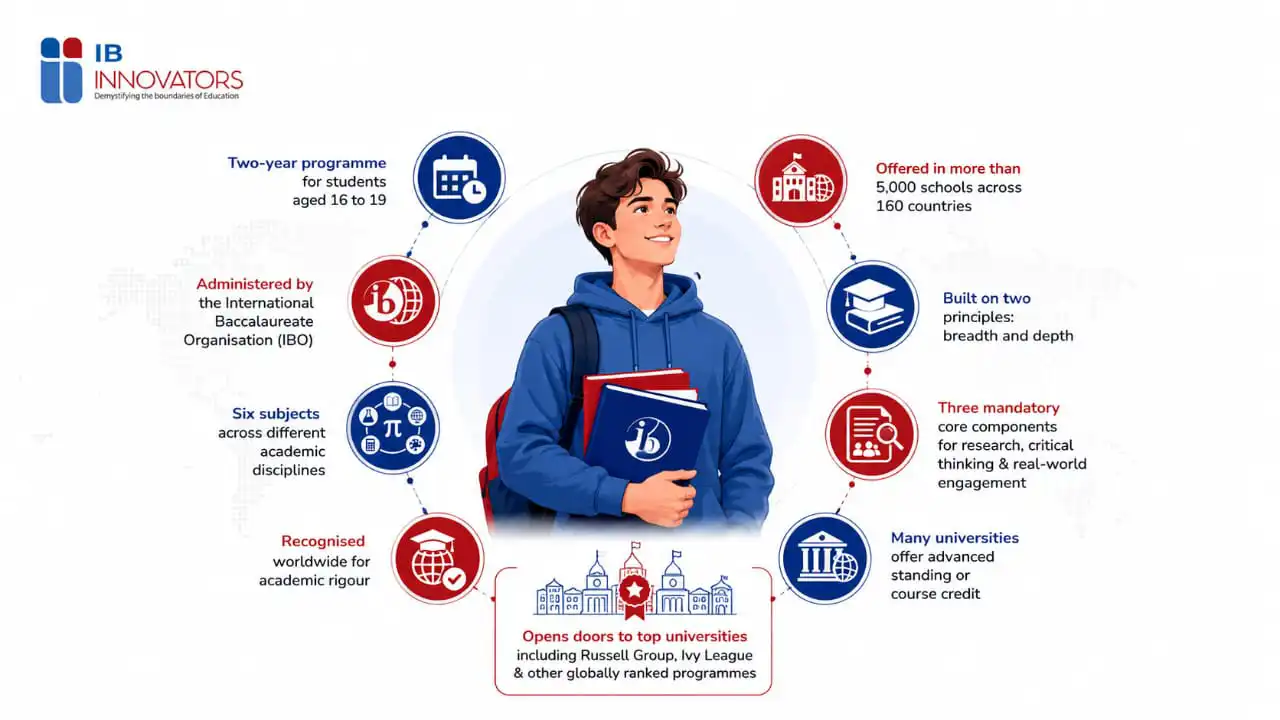
Quick Fact: The IB Diploma is scored out of a maximum of 45 points. The minimum score required to be awarded the diploma is 24 points. |
IB Diploma Requirements at a Glance
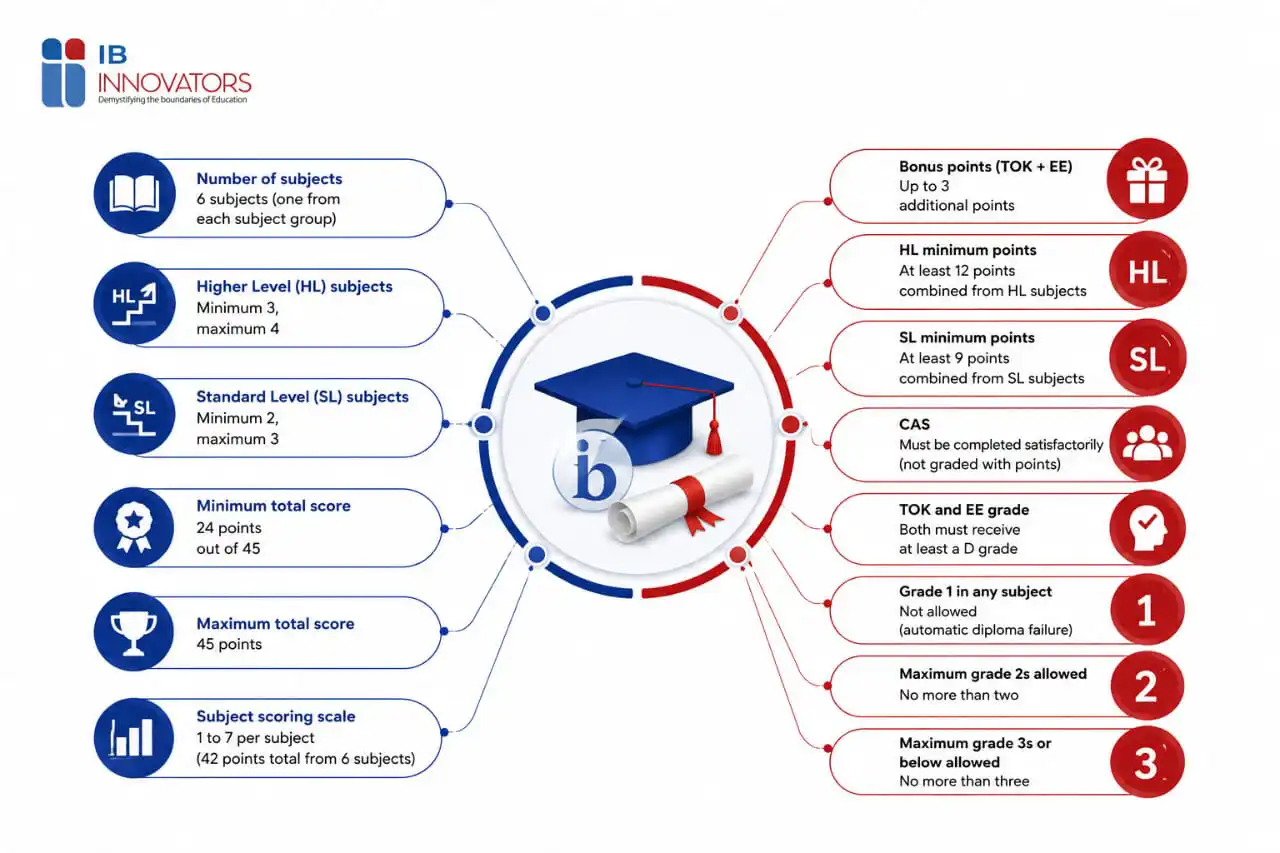
Before we go into detail, here is a quick reference summary of everything you need to earn the IB Diploma:
Requirement | What You Need |
Number of subjects | 6 subjects (one from each subject group) |
Higher Level (HL) subjects | Minimum 3, maximum 4 |
Standard Level (SL) subjects | Minimum 2, maximum 3 |
Minimum total score | 24 points out of 45 |
Maximum total score | 45 points |
Subject scoring scale | 1 to 7 per subject (42 points total from 6 subjects) |
Bonus points (TOK + EE) | Up to 3 additional points |
HL minimum points | At least 12 points combined from HL subjects |
SL minimum points | At least 9 points combined from SL subjects |
CAS | Must be completed satisfactorily (not graded with points) |
TOK and EE grade | Both must receive at least a D grade |
Grade 1 in any subject | Not allowed (automatic diploma failure) |
Maximum grade 2s allowed | No more than two |
Maximum grade 3s or below allowed | No more than three |
The 6 IB Subject Groups Explained
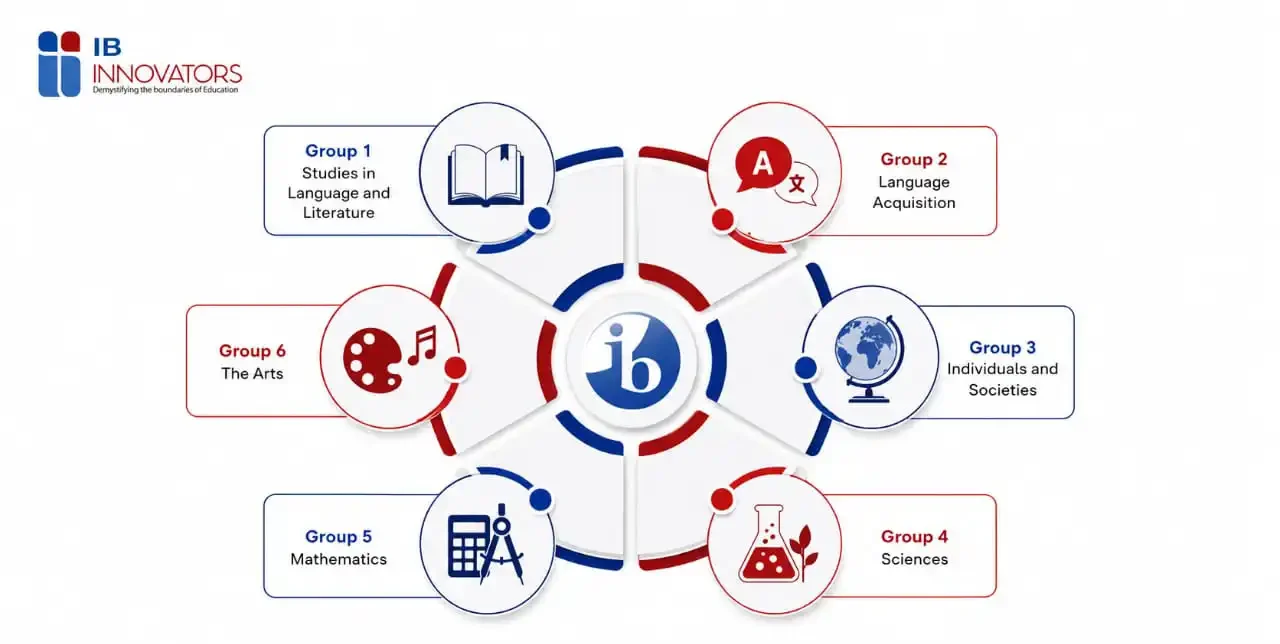
Every IB Diploma student must choose one subject from each of the six subject groups. This structure ensures students develop breadth of knowledge across humanities, sciences, languages, and the arts, rather than specialising too early.
Group 1: Studies in Language and Literature
This group focuses on your strongest language, typically English for most international students. Students study literary texts, develop analytical writing skills, and explore how language shapes meaning and culture. Assessment includes written and oral components.
Group 2: Language Acquisition
Students study an additional language, either learning a new one or developing proficiency in one they already know. This group reflects the IBO’s commitment to intercultural understanding and prepares students for a multilingual world.
Group 3: Individuals and Societies
This group covers the social sciences and humanities, including Economics, History, Business Management, Geography, and Psychology. Students examine societal structures, global systems, and the forces that shape human behaviour. At IB Innovators, we offer dedicated tutoring for IB Economics, IB Business Management, and IB Psychology.
Group 4: Sciences
Students choose from Biology, Chemistry, Physics, Computer Science, or Environmental Systems and Societies (ESS). Science subjects involve both theoretical understanding and practical laboratory work. Our specialist tutors cover IB Biology, IB Chemistry, IB Physics, and IB Environmental Systems and Societies.
Group 5: Mathematics
Students choose between Mathematics: Analysis and Approaches (AA) and Mathematics: Applications and Interpretation (AI). Both are offered at HL and SL, catering to students with different mathematical strengths and ambitions. Our IB Mathematics tutors specialise in both AA and AI at all levels.
Group 6: The Arts
Students may study Visual Arts, Music, Theatre, Film, or Dance. Alternatively, students can replace the Arts subject with a second subject from Groups 1 to 5. This flexibility allows students to focus on their individual strengths.
Higher Level vs Standard Level: What Is the Difference?
Every IB subject is studied at one of two levels: Higher Level (HL) or Standard Level (SL). Students must take a minimum of three subjects at HL and a maximum of four. The remaining subjects are taken at SL.
This is one of the most important decisions an IB student makes. HL subjects require significantly more time and depth, but they also signal to universities that you have engaged seriously with a particular discipline.
| Higher Level (HL) | Standard Level (SL) |
Teaching hours | 240 hours over 2 years | 150 hours over 2 years |
Depth of study | Greater depth, additional topics and tasks | Broad understanding, fewer components |
Minimum subjects required | At least 3 (maximum 4) | At least 2 (maximum 3) |
Minimum points to pass | 12 points combined from HL subjects | 9 points combined from SL subjects |
Best suited for | Future university majors and specialist interests | Supporting subjects and broader balance |
Assessment weighting | Higher marks available; more complex papers | Shorter exam papers in most subjects |
Strategy Tip: Choose your HL subjects based on your intended university course, not just your current grades. A student targeting Medicine should prioritise Biology or Chemistry HL. A student aiming for Economics should consider Economics HL. |
The 3 Core Components: TOK, Extended Essay, and CAS
Beyond the six academic subjects, every IB Diploma student must complete three core components. These are mandatory for all diploma candidates and cannot be skipped, regardless of how high your subject scores are.
Theory of Knowledge (TOK)
Theory of Knowledge is a unique philosophical component that asks students to reflect on how we know what we know. It challenges students to explore knowledge questions across different disciplines, such as the sciences, arts, mathematics, and history.
Assessment has two parts:
- A TOK Exhibition in which students select three real-world objects or artefacts and connect them to a core knowledge question. This is assessed internally by the school.
- A TOK Essay of 1,600 words written on a prescribed title set by the IBO. This is marked externally by an IB examiner.
TOK is graded from A (highest) to E (lowest). A grade of E in TOK is a diploma failure condition, regardless of your total points. Our 1-on-1 IB Guidance and Support sessions can help you plan and structure both components effectively.
The Extended Essay (EE)
The Extended Essay is a self-directed research project in which students write a 4,000-word academic paper on a topic of their choosing within a specific IB subject. It is the closest a pre-university student gets to undergraduate-level independent research.
The EE process includes:
- Choosing a focused research question within your chosen subject
- Working with a school supervisor across multiple reflection sessions
- Conducting independent research, including primary and secondary sources
- Producing a formal academic essay with proper citations and structure
The EE is graded from A to E and contributes bonus points to your total score when combined with your TOK grade. A grade of E in the Extended Essay is a diploma failure condition. For expert support with topic selection, structure, and feedback, visit our IB Extended Essay Guidance page.
For topic inspiration, browse our blog on 30+ Extended Essay Topics by Subject.
Creativity, Activity, Service (CAS)
CAS is the experiential learning component of the IB Diploma. It requires students to engage in meaningful activities across three strands over a minimum of 18 months, with regular written reflections on their experiences.
The three strands are:
- Creativity: Activities involving creative thinking and expression, such as learning an instrument, photography, or starting a school publication.
- Activity: Physical challenges and health-related pursuits, such as playing team sports, dance, or outdoor adventures.
- Service: Genuine community engagement where students identify real needs and collaborate on projects to address them. This goes beyond one-off volunteering and requires sustained involvement.
CAS is not graded with points and does not directly add to your total score. However, failing to complete CAS requirements satisfactorily means you will not be awarded the diploma, even if your point total is well above 24.
TOK and Extended Essay Bonus Points: How It Works
Your TOK and Extended Essay grades are combined to award up to 3 bonus points on top of your six subject scores. This means a student with 42 subject points and an A in both TOK and the EE will earn the maximum of 45 points.
The bonus points matrix is as follows:
Extended Essay Grade | TOK: A | TOK: B | TOK: C | TOK: D | TOK: E |
A | 3 points | 2 points | 0 points | 0 points | FAIL (N) |
B | 2 points | 1 point | 0 points | 0 points | FAIL (N) |
C | 0 points | 0 points | 0 points | 0 points | FAIL (N) |
D | 0 points | 0 points | 0 points | 0 points | FAIL (N) |
E | FAIL (N) | FAIL (N) | FAIL (N) | FAIL (N) | FAIL (N) |
Not submitted | FAIL (N) | FAIL (N) | FAIL (N) | FAIL (N) | FAIL (N) |
Important: If either your TOK or EE receives a grade of E, or if you fail to submit either component, you will not be awarded the IB Diploma regardless of your total point score. |
The IB Scoring System Explained
Each of your six IB subjects is graded on a scale from 1 to 7. A grade of 7 represents the highest level of achievement, while a grade of 1 represents the lowest.
Grade | Descriptor | What It Means |
7 | Excellent | Exceptional understanding; consistent high performance across all assessment components |
6 | Very Good | Strong grasp of material with minor gaps; high-level analytical ability demonstrated |
5 | Good | Sound understanding with some areas for improvement; good exam technique |
4 | Satisfactory | Adequate understanding of core content; meets minimum academic expectations |
3 | Mediocre | Limited understanding; only partial achievement of course objectives |
2 | Poor | Very limited achievement; significant gaps in knowledge and understanding |
1 | Very Poor | Minimal achievement; fails to meet the basic requirements of the course |
The maximum score from all six subjects is 42 points (6 subjects multiplied by a maximum of 7 each). Adding the maximum 3 bonus points from TOK and the EE brings the absolute maximum total to 45 points.
Target Tip: Aim for an average grade of 5 or above across all subjects. A score of 5 in each of your 6 subjects gives you 30 points, which is a solid diploma pass and competitive for most university applications. |
How Many Points Do You Need to Pass the IB Diploma?
To be awarded the IB Diploma, you must meet all of the following conditions simultaneously. Scoring 24 total points alone is not sufficient if any of the other conditions below are not met.
The minimum requirements are:
- Total score of at least 24 points out of a possible 45
- At least 12 points from your Higher Level (HL) subjects combined
- At least 9 points from your Standard Level (SL) subjects combined
- A grade of D or above in both TOK and the Extended Essay
- Satisfactory completion of all CAS requirements
- No grade of 1 in any subject
- No more than two grades of 2 across all subjects
- No more than three grades of 3 or below across all subjects
It is important to note that these conditions apply simultaneously. A student can have a total of 30 points but still fail the diploma if they receive a grade of 1 in one subject, or if they have not completed CAS.
The 7 Diploma Failing Conditions: A Complete Checklist
This section is one of the most important in the entire guide. Most competitor blogs do not clearly list all seven diploma failure conditions in one place. Understanding these conditions can be the difference between graduating and not.
The IBO will not award the IB Diploma if any of the following conditions apply, regardless of total score:
- Grade E in TOK or the Extended Essay. An E grade in either core component is an automatic diploma failure. Even if you score 40+ points in your subjects, an E in TOK or the EE means no diploma.
- Failure to submit TOK or the Extended Essay. If either component is not submitted, it is treated the same as an E grade and the diploma is not awarded.
- CAS requirements not satisfactorily completed. If you have not completed and documented your CAS activities across all three strands, the diploma is withheld regardless of academic performance.
- Grade 1 awarded in any subject. A score of 1 in any single subject, at either HL or SL, is a diploma failure condition. No exceptions apply.
- More than two grades of 2. If you receive a grade of 2 in three or more subjects, the diploma will not be awarded.
- More than three grades of 3 or below. If four or more of your subjects receive a grade of 3 or lower, the diploma is not awarded. This counts grades of 1, 2, and 3 combined.
- HL score below 12 points or SL score below 9 points. If the combined total of your Higher Level subject grades is less than 12 points, the diploma is not awarded, even if your total score is 24 or above. If your SL subjects combine to fewer than 9 points, the diploma is also withheld.
Critical: These failing conditions are why students with seemingly reasonable total scores still fail to receive the diploma each year. Being aware of all seven conditions from day one is essential. |
If you are at risk of any of the above, our Rapid Revision and IB Exam Retakes Course is designed specifically for students who need targeted, high-intensity support.
IB Diploma vs IB Certificate: What Is the Difference?
This is a distinction that four out of five of the top-ranking competitor blogs fail to address clearly. Many students and parents are unaware that the IB Diploma and the IB Certificate are two different things, and this confusion can significantly affect university application strategies.
Feature | IB Diploma | IB Certificate |
What it is | Full qualification requiring all 6 subjects, TOK, EE, and CAS | Individual subject-level recognition without the full diploma requirements |
Core components required | Yes: TOK, Extended Essay, and CAS are all mandatory | No: students may take individual subjects without core components |
Minimum subjects | 6 subjects across all 6 subject groups | Students may take 1 or more individual IB courses of their choice |
University recognition | Fully recognised globally; strongly preferred by top universities | Recognised as IB coursework but does not carry the same weight as the full diploma |
Bonus points | Up to 3 bonus points from TOK and EE combined | Not applicable within the certificate framework |
Best suited for | Students seeking the full IB qualification for competitive university entry | Students who want IB-level rigour in specific subjects alongside other qualifications |
Advanced standing at universities | Often awarded for scores of 5, 6, or 7 in HL subjects | Considered on a case-by-case basis; less commonly leads to advanced standing |
Impact on university offers | Strong positive signal for top UK and global universities | Weaker signal; treated more like advanced coursework than a standalone qualification |
The key takeaway is that universities, particularly those in the UK and US, strongly prefer the full IB Diploma over individual certificates. If you are pursuing entry to a Russell Group university or an Ivy League institution, completing the full diploma is significantly more advantageous.
Internal Assessments vs External Assessments: How Your Grade Is Built
Your final grade in each IB subject is not determined solely by your end-of-year examinations. It is a combination of two assessment types: Internal Assessments and External Assessments.
Internal Assessments (IAs)
Internal Assessments are subject-specific coursework tasks, such as lab reports, oral presentations, essays, or investigative projects. They are marked initially by your classroom teacher and then moderated by the IBO to ensure consistent standards globally.
Key facts about IAs:
- IAs typically contribute between 20% and 30% of your final subject grade
- They are completed during the course and submitted well before final exams
- Because they are not timed exam conditions, IAs are an opportunity to demonstrate genuine understanding and interest in a topic
- Guidance and Support sessions at IB Innovators are specifically designed to help with IA planning, structure, and detailed feedback before submission
External Assessments (EAs)
External Assessments are the formal written examinations taken at the end of the two-year programme, in May or November. They are marked by trained IBO examiners rather than your school teachers.
Key facts about EAs:
- External exams typically carry between 70% and 80% of your final subject grade
- Papers vary by subject and level; some subjects include Paper 1, Paper 2, and Paper 3
- All external exams are sat in a single examination session (May for most students)
- Our IB Mocks and Exam Preparation Course provides structured exam practice with mark-scheme feedback from certified IB examiners
Predicted Grades: What They Are and Why They Matter
Before your final examinations, your subject teachers will assign you a predicted grade for each subject. These predicted grades are based on your IA performance, in-class assessments, and mock examination results.
Predicted grades matter enormously for university applications. In the UK, UCAS applications are submitted in Year 13, before final IB results are available. Universities therefore make conditional offers based on your predicted grades. A student predicted 38 points may receive an offer from a top university requiring a final score of 36.
Performing consistently well throughout Year 12 and into Year 13 directly shapes the predicted grades your teachers assign.
University Entry Requirements for IB Diploma Students
The IB Diploma is recognised and respected by universities worldwide. Below are typical minimum total scores required by leading UK universities for competitive undergraduate programmes.
University | Typical IB Score Range | Notes |
University of Oxford | 38 to 40 points | HL requirements: typically 7, 6, 6 in relevant subjects |
University of Cambridge | 40 to 42 points | HL requirements: typically 7, 7, 6 depending on course |
University College London (UCL) | 35 to 38 points | HL requirements vary; subject-specific conditions apply |
Imperial College London | 36 to 39 points | Strong emphasis on science and maths HL performance |
London School of Economics | 37 to 39 points | Mathematics and Economics HL commonly required |
King’s College London | 34 to 37 points | HL requirements set at subject level |
University of Edinburgh | 34 to 36 points | Medicine and science courses have higher HL conditions |
University of Manchester | 33 to 37 points | Wide range depending on faculty |
University of Bristol | 32 to 36 points | Competitive courses require higher HL scores |
University of Glasgow | 32 to 35 points | Standard entry for most undergraduate programmes |
What Happens If You Do Not Pass the IB Diploma?
Failing to meet the diploma requirements is not the end of the road. The IBO offers structured options for students who do not receive the diploma on their first attempt.
IB Retake Sessions
Students who do not pass the IB Diploma may apply to retake examinations in two sessions:
- May Session: The primary examination window held each year, attended by most IB students.
- November Session: A secondary examination window available to retake candidates from all regions.
Students typically have up to two additional examination sessions to improve their scores. Consult your school’s IB Coordinator to confirm the specific retake options available to you.
What Can Be Retaken?
- Individual subject examinations (written papers)
- TOK essay (with a new prescribed title from the active exam session)
- Extended Essay (with a new research question)
- CAS requirements (further activities can be documented if not satisfactorily completed)
If you are preparing for a retake, our Rapid Revision and IB Exam Retakes Course and IB Winter Bootcamp are built precisely for this situation.
Expert Tips to Pass the IB Diploma
Based on the experience of our certified IB examiners and tutors at IB Innovators, who have guided thousands of students across every subject and every score band, here are the most impactful strategies for diploma success.
1. Prioritise Your Internal Assessments Early
IAs contribute up to 30% of your final grade in many subjects. Start your IA planning in Year 1, not Year 2. Seek feedback from your teacher and from an expert tutor before submission.
2. Understand the Mark Scheme, Not Just the Content
IB examiners award marks based on specific descriptors. Understanding precisely what examiners are looking for dramatically improves your ability to target marks efficiently. Our IB Exam Tips from Examiners article covers this in detail.
3. Do Not Neglect the Core Components
Many students treat TOK and the Extended Essay as secondary to their subject examinations. This is a significant mistake. An E in either component is an automatic diploma failure, and leaving preparation until the last minute is one of the most common reasons students underperform.
4. Use Past Papers Consistently
Practising with authentic past papers is one of the most evidence-based revision strategies available. See our guide on IB Paper Strategies by Subject for subject-specific advice.
5. Monitor Your Score Trajectory Throughout the Programme
Do not wait until your mock exams to understand where you stand. Track your IA marks, class test results, and teacher feedback from the beginning of Year 1. Identify which subjects are at risk of low grades and seek support early.
6. Manage Time and Wellbeing Proactively
Create a weekly study schedule, build in recovery time, and recognise that sustainable performance across two years is more valuable than intense short-term effort followed by burnout.
7. Seek Expert Support Before It Becomes Urgent
Students at IB Innovators who engage tutoring support in Year 1 consistently outperform those who only seek help in the final months before exams. Whether you need 1-on-1 tutoring, group revision courses, or guidance on your Extended Essay or IAs, earlier is always better.
Ready to Build Your IBDP Foundation?
Whether you are entering Year 12, midway through the programme, or preparing for May exams, IB Innovators has a session format built for your stage.
Book Your Free 30-Minute Consultation at IB Innovators | Contact Us